

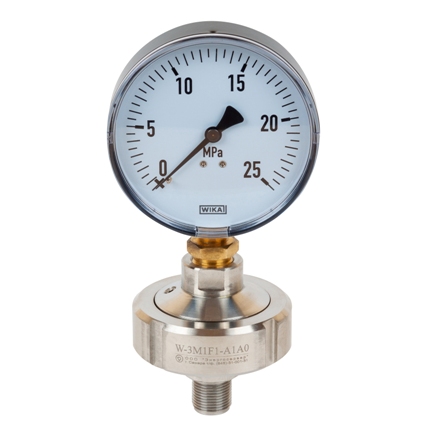
Description
The separation vessel is designed to protect the sensitive element of a measuring instrument (pressure gauge, pressure transmitter, pressure relay, etc.) from exposure to a wide range of aggressive operating media.
Due to the absence of diffusion through the metal diaphragm, it can be recommended for pressure measurement of both liquid and gaseous aggressive media.
Applications
Contaminated media
Liquid media
Gaseous aggressive media
Highly viscous media
Design: Detachable, with internal diaphragm placement.
Process connection: Nozzle, metric thread, BSP or NPT.
Features: Filling only with vacuum equipment; possibility of replacing individual parts.
Operating pressure range, kgf/cm²: –1…250
Additional information: Reference codebook for Separation Vessel Type W.
Characteristics
| Accuracy Class of Device-Separator Set | within the reference accuracy class of the instrument |
| Connection | nozzle, threaded |
| Connection to Measuring Device | internal metric thread, BSP or NPT |
| Construction | detachable |
| Design | standard, with flushing hole |
| Housing Material | carbon steel, stainless steel, lined steel, molybdenum steel, chromium-nickel steel, Hastelloy, titanium |
| Minimum Upper Measurement Limit of Device, kgf/cm² | 0,1…1 |
| Operating Temperature Range, °C | -50...260 |
| Process Connection | nozzle with external or internal metric, BSP, or NPT thread |
| Seal Ring Material | rubber, PTFE |
| Separation Element | diaphragm |
| Separation Element Diameter, mm | 50…120 |
| Separation Element Material | stainless steel, molybdenum steel, tantalum, molybdenum steel with PTFE coating, molybdenum steel with TiN coating, titanium, Monel |